
Claude Fable 5 is Anthropic’s newest public Claude model and its first widely available Mythos-class release.
In simple terms, it is built for harder AI tasks: complex coding, deeper research, long documents, visual analysis and advanced AI workflows.
The important distinction is that Claude Fable 5 is the public version, while Claude Mythos 5 is the restricted version for approved partners.
For most users, Fable 5 is the one to pay attention to. It gives Claude users access to more advanced reasoning while still keeping extra safeguards in place.
Important update — June 12, 2026: Anthropic has suspended access to Claude Fable 5 and Claude Mythos 5 for all customers following a U.S. government export-control directive. Anthropic says it is working to restore access. Other Claude models remain available.
This guide has been updated and remains useful for understanding Claude Fable 5’s capabilities, use cases, and what to expect if access returns.
What is Claude Fable 5?
Claude Fable 5 is Anthropic’s new Mythos-class AI model for advanced reasoning, long-context work, coding, research, vision, and agent-style workflows.
In simple terms, Claude Fable 5 is designed for harder tasks that require more thinking, more context, and more follow-through.
A normal AI model can help you:
- Rewrite a paragraph
- Summarize a short article
- Draft a basic email
- Brainstorm social media ideas
- Explain a concept
Claude Fable 5 is designed for bigger tasks like
- Reviewing a large codebase
- Debugging complex technical problems
- Comparing long documents
- Analyzing charts, tables, dashboards, and screenshots
- Creating advanced research briefs
- Planning multi-step workflows
- Helping build AI agent systems
- Working through complex business or product strategy
The biggest difference is not just that Claude Fable 5 is “smarter.”
The bigger difference is that it is built for more serious work. It can hold more context, work through more steps, and help with tasks that feel too large, messy, or complicated for a basic AI prompt.
Why Claude Fable 5 matters
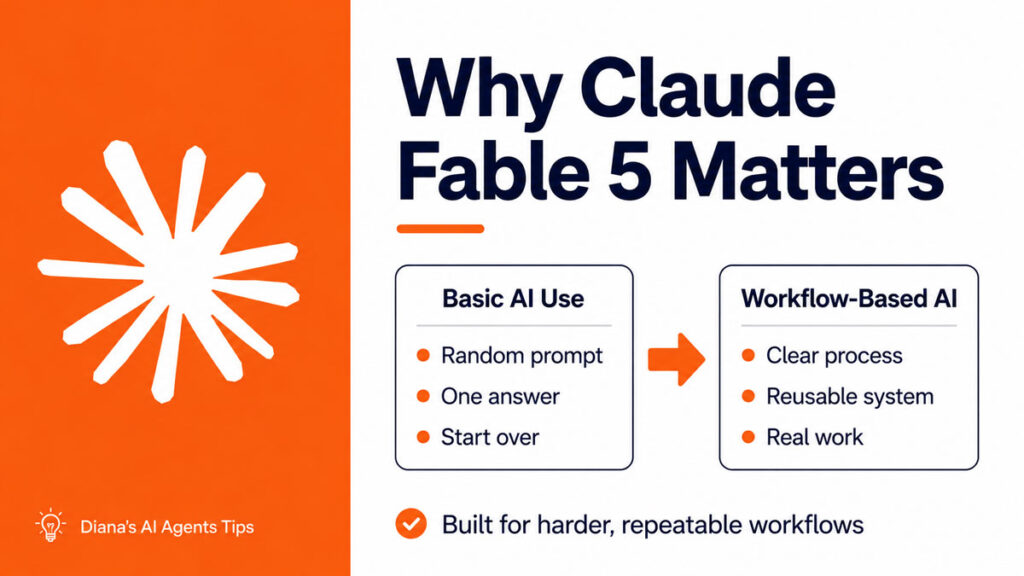
Claude Fable 5 matters because AI is moving from simple chat to workflow-based work.
Most people still use AI like this:
- Open Claude, ChatGPT, or Gemini.
- Type a random prompt.
- Get an answer.
- Start over again the next day.
That works for basic tasks.
But the next stage of AI is different.
The next stage is about creating repeatable workflows that help you complete real work more consistently.
Instead of asking:
Give me content ideas.
A better AI workflow might:
- Review your business.
- Identify your audience.
- Create post angles.
- Write hooks.
- Draft captions.
- Suggest images.
- Create follow-up emails.
- Recommend a CTA.
- Turn the idea into a reusable skill.
That is a much more powerful way to use AI.
Claude Fable 5 matters because it is built for this type of harder, longer, more structured work.
For beginners, business owners, creators, and marketers, that is the real opportunity.
You do not need to become a technical AI expert. But you do need to learn how to turn repeat tasks into clear AI workflows.
Claude Fable 5 vs Claude Mythos 5
Claude Fable 5 and Claude Mythos 5 are closely related, but they are not available in the same way.
Claude Fable 5 is the public Mythos-class model with extra safeguards.
Claude Mythos 5 is the restricted version available only to approved organizations through Anthropic’s Project Glasswing program.
Here is the simple comparison:
| Model | Simple explanation | Access |
|---|---|---|
| Claude Fable 5 | Public Mythos-class model with safeguards | Generally available |
| Claude Mythos 5 | Restricted Mythos-class model with fewer safeguards in certain areas | Approved partners only |
| Claude Opus 4.8 | Anthropic’s next-most-capable Opus model | Generally available |
The most important thing to know is this:
Claude Fable 5 is the version most people should pay attention to.
It gives regular Claude users and developers access to more advanced capabilities while keeping certain sensitive areas restricted.
You can read Anthropic’s official launch announcement here: Claude Fable 5 and Claude Mythos 5.
Why does Claude Fable 5 have safeguards?
Claude Fable 5 is extremely capable, especially in technical and scientific areas.
That creates a challenge.
The same intelligence that can help a developer debug software or help a researcher analyze complex information could also be misused in high-risk areas.
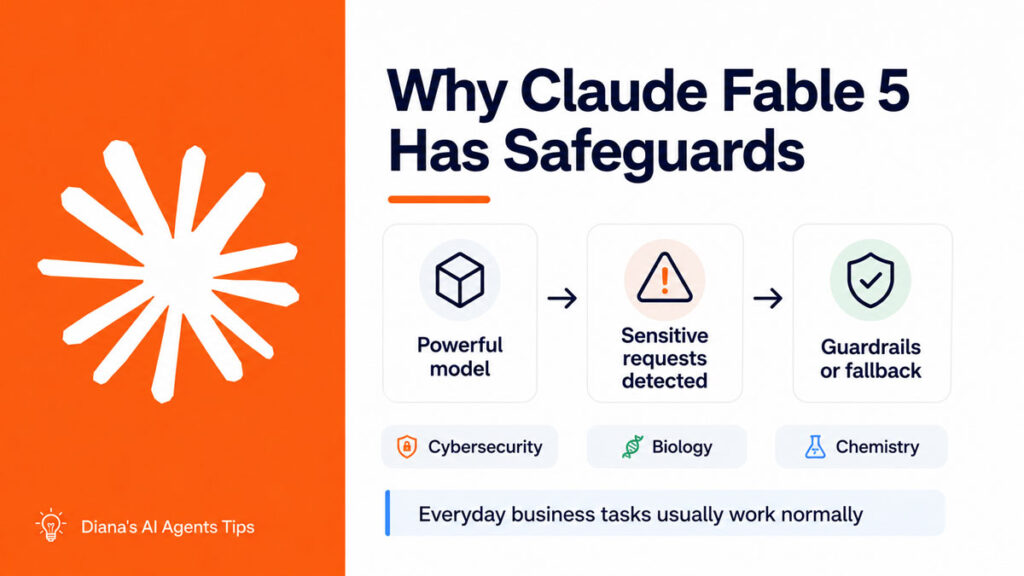
To manage that, Anthropic added safety classifiers to Claude Fable 5.
These classifiers can detect certain sensitive requests and route them away from Fable 5. In some cases, the request may be handled by Claude Opus 4.8 instead.
For everyday users, this usually will not matter.
If you are using Claude Fable 5 for normal business work, content planning, research summaries, website audits, document analysis, workflow design, or productivity tasks, you may never notice the fallback.
But if a prompt involves sensitive cybersecurity, biology, chemistry, or model-distillation behavior, the safeguards may trigger.
Beginner translation: Claude Fable 5 is powerful enough that Anthropic added extra guardrails before making it public.
Claude Fable 5 vs Claude Opus 4.8
Claude Opus 4.8 is still a strong model.
But Claude Fable 5 is positioned above Opus for more complex work.
Use Claude Opus 4.8 when you need strong results for everyday writing, analysis, coding, and reasoning.
Use Claude Fable 5 when the task is bigger, harder, longer, or more important.
Claude Fable 5 may be better for:
- Large coding projects
- Advanced debugging
- Multi-document research
- Long reports
- Technical analysis
- Complex visual analysis
- Business strategy
- AI agent workflows
- Website and SEO audits
- Tasks with many moving parts
Claude Opus 4.8 may be better for:
- Shorter writing tasks
- Simple summaries
- Everyday brainstorming
- Lower-cost work
- Quick edits
- Routine prompts
- Tasks that do not need the strongest model
A simple way to think about it:
Claude Opus 4.8 is powerful.
Claude Fable 5 is for the hardest work.
Best use cases for Claude Fable 5
Claude Fable 5 is not necessary for every AI task.
You do not need the most powerful model to write a simple caption, summarize a short paragraph, or draft a quick email.
Claude Fable 5 is most useful when normal AI starts to struggle.
Also read The 12 Best Claude Fable 5 Use Cases (With Prompts) for even more ideas for your business.
1. Complex coding and debugging
Claude Fable 5 is especially important for software engineering and coding workflows.
- Debugging complex code
- Reviewing large projects
- Planning migrations
- Refactoring old code
- Explaining technical problems
- Creating implementation plans
- Reviewing architecture
- Understanding unfamiliar codebases
- Turning product ideas into technical plans
For non-developers, this still matters.
You may not be writing code yourself, but you may need to communicate better with a developer, review a website issue, understand a bug, create clearer app requirements, or turn a business idea into a technical brief.
Claude Fable 5 can help translate technical complexity into clearer next steps.
2. Advanced research
Claude Fable 5 is useful for research that requires more than a quick summary.
- Compare multiple sources
- Identify what changed in an announcement
- Create a research brief
- Extract key points from long documents
- Find patterns across articles
- Organize conflicting viewpoints
- Explain technical updates in beginner-friendly language
- Turn research into content ideas
This is especially helpful for creators, founders, consultants, marketers, educators, and business owners.
AI news moves fast. Claude Fable 5 can help you understand what matters, what does not, and how to turn a complex update into something useful for your audience.
3. Visual analysis
Claude Fable 5 is also strong for visual tasks.
- Screenshots
- Charts
- Tables
- Dashboards
- Website layouts
- App screens
- Diagrams
- Presentations
- PDF pages
- Design mockups
- Social media graphics
For business owners and creators, this is practical.
You can use Claude Fable 5 to review a homepage screenshot, analyze a landing page, critique a carousel, study a dashboard, or explain what is confusing in a design.
Instead of only asking AI to write, you can ask it to look, compare, interpret, and improve.
4. Long documents and large projects
Claude Fable 5 is built for long-context work.
That makes it useful when you have a lot of material to review.
- Long reports
- Strategy documents
- Research files
- Meeting transcripts
- Course outlines
- Website copy
- Brand documents
- Product specs
- Customer feedback
- Sales page drafts
- Training materials
This matters because real work is rarely contained in one tiny prompt.
Real work usually includes scattered notes, examples, goals, old drafts, source material, screenshots, instructions, and constraints.
Claude Fable 5 is better suited for those larger, messier projects.
5. AI agent workflows
Claude Fable 5 is very relevant for people learning AI agents.
An AI agent workflow is a repeatable process that helps AI complete a task more consistently.
Instead of starting from scratch every time, you give AI:
- A role
- A goal
- Context
- Inputs
- Steps
- Rules
- Output format
- Quality checklist
That turns a one-time prompt into a reusable system.
For example, instead of asking:
Help me with SEO.
You could create an SEO workflow that:
- Reviews the page topic.
- Identifies search intent.
- Suggests the best title.
- Creates an H1 and H2 structure.
- Finds internal link opportunities.
- Writes a meta description.
- Creates FAQ questions.
- Gives a final optimization checklist.
That is much more useful than one random prompt.
Is Claude Fable 5 good for beginners?
Yes, but beginners should use it intentionally.
Claude Fable 5 is powerful, but that does not mean every beginner needs it for every task.
The key is not just using a stronger model.
The key is giving the model a better task.
Beginners often ask vague prompts like:
- Make this better.
- Give me ideas.
- Help me with my business.
- What should I do?
- Write something good.
Claude Fable 5 can do much more when you give it a clear workflow.
A better prompt would be:
Review this landing page for a beginner audience. Focus on clarity, search intent, trust, CTA placement, and whether the offer is easy to understand. Give me the top 10 fixes in priority order, then rewrite the weakest section.
That gives Claude Fable 5 a real job.
Do you need Claude Fable 5?
You do not need Claude Fable 5 for everything.
Use a smaller or faster model for simple tasks.
Use Claude Fable 5 when the task is complex, high-value, long, or difficult.
You probably do not need Fable 5 for:
- Simple captions
- Quick rewrites
- Short emails
- Basic summaries
- Simple brainstorming
- Everyday chat
You may want Claude Fable 5 for:
- Advanced research
- Long documents
- Coding help
- Website audits
- Business strategy
- Visual analysis
- AI agent workflows
- Complex planning
- Multi-step tasks
A good rule:
Use simple models for simple work.
Use Claude Fable 5 when you need deeper thinking.
How to use Claude Fable 5
The easiest way to use Claude Fable 5 is inside Claude if it is available in your account.
Developers can also use it through the Claude API and supported platforms. Anthropic lists the model ID as claude-fable-5 in its Claude model documentation.
But for beginners, the most important question is not:
How do I access the API?
The better question is:
What workflow should I give this model?
Start with one task you already repeat.
- Research AI news
- Audit a website page
- Turn one blog post into social content
- Review a sales page
- Summarize long notes
- Organize a business idea
- Compare competitor offers
- Create a weekly planning system
Then turn that task into a reusable AI workflow.
Not sure what workflow to build first? Try the Free AI Agent Generator to turn one business task into a simple AI workflow you can customize.
Beginner framework for Claude Fable 5 workflows
Use this simple framework when working with Claude Fable 5.
Step 1: Pick one repeatable task
Choose a task you do often, such as content planning, research summaries, website reviews, competitor research, email drafting, document organization, weekly planning, or social media repurposing.
Step 2: Define the goal
Write the goal in one sentence.
The goal is to turn one AI news update into a beginner-friendly blog post, Facebook post, and email idea.
Step 3: Give Claude the context
Tell Claude what it needs to know. This may include your audience, offer, brand voice, product, topic, source material, and desired outcome.
Step 4: Give Claude the process
Do not only ask for the final answer. Tell Claude how to think through the work.
First summarize what changed. Then explain why it matters. Then identify beginner use cases. Then create a blog outline. Then write the post. Then create SEO metadata.
Step 5: Define the output
Tell Claude exactly what you want back. Examples include a table, checklist, blog post, prioritized action list, content calendar, research brief, or rewritten page section.
Step 6: Review and improve
Claude Fable 5 is powerful, but you should still review the output. AI can help you move faster, but you are still responsible for checking accuracy, tone, facts, links, and final decisions.
Example Claude Fable 5 prompt for beginners
Here is a simple starter prompt you can try:
Act as my AI workflow strategist. I want to turn a repeatable business task into a clear AI agent workflow. The task is: [insert task]. My audience is: [insert audience]. My goal is: [insert goal]. Create a beginner-friendly workflow with the purpose, required inputs, step-by-step process, output format, quality checklist, and one reusable prompt I can save.
This works because it does not just ask Claude for one answer.
It asks Claude to help build a reusable system.
That is the real value of advanced AI models like Claude Fable 5.
Claude Fable 5 for content creators
Claude Fable 5 can be useful for creators because content creation is usually more than writing.
A strong content workflow includes:
- Research
- Positioning
- Audience awareness
- Hook writing
- Drafting
- Editing
- Repurposing
- SEO
- CTA strategy
- Follow-up content
Claude Fable 5 can help turn one idea into multiple assets.
- Blog post outline
- SEO title
- Meta description
- Facebook post
- Carousel text
- Email idea
- Short video hook
- FAQ section
- Lead magnet angle
This helps creators stop treating every platform as a separate task. One strong idea can become a full content system.
If you want ready-to-use workflow examples, explore the done-for-you AI agent skills inside AI Agents Library.
Claude Fable 5 for business owners
Business owners can use Claude Fable 5 for planning, research, and decision support.
- Reviewing offers
- Improving website copy
- Comparing competitors
- Organizing customer feedback
- Creating SOPs
- Writing onboarding materials
- Planning launches
- Creating content calendars
- Auditing sales pages
- Summarizing business notes
The best way to use Claude Fable 5 for business is to give it real context.
Instead of asking:
What should I do to grow my business?
Ask:
Review this offer, audience, sales page copy, and current traffic source. Identify the top 5 conversion issues, the strongest positioning angle, and the next 3 actions I should take.
Claude Fable 5 works better when the task is specific.
If you want a more structured path for building practical workflows, explore the AI Agent Academy.
Claude Fable 5 for AI agents
Claude Fable 5 is especially interesting for AI agent builders.
AI agents are not just prompts.
They are structured workflows that help AI complete repeatable tasks.
A basic AI agent skill might include:
- Purpose
- Best use case
- Required inputs
- Step-by-step instructions
- Output format
- Examples
- Quality checks
- Troubleshooting notes
Claude Fable 5 can help create, test, and improve those workflows.
For example, you could use it to build:
- AI news agent
- Weekly business brief agent
- SEO audit agent
- Content repurposing agent
- Competitor research agent
- Website copy audit agent
- Client onboarding agent
- Email follow-up agent
- Research summary agent
- Social media planning agent
The real advantage is consistency.
Instead of trying to remember the perfect prompt every time, you create a workflow once and reuse it.
For another AI workflow guide, read What Is Gemini Spark?.
Common mistakes to avoid with Claude Fable 5
Mistake 1: Asking vague prompts
Bad prompt:
Help me with my business.
Better prompt:
Review my homepage copy for a beginner audience and identify the top 10 clarity, trust, and conversion issues in priority order.
Mistake 2: Using Fable 5 for tiny tasks
You do not need Claude Fable 5 for every short caption or basic rewrite. Save it for harder tasks where the extra reasoning matters.
Mistake 3: Giving no context
Claude Fable 5 is only as useful as the information you provide. Give it the audience, goal, source material, constraints, and desired output.
Mistake 4: Treating the first answer as final
Use Claude Fable 5 like a work partner. Ask it to improve, challenge, organize, compare, and prioritize.
The best output often comes after a few rounds of refinement.
Mistake 5: Not turning good prompts into reusable workflows
If a prompt works well, save it.
Turn it into a reusable AI skill or workflow so you do not start over next time.
Claude Fable 5 and the future of AI workflows
Claude Fable 5 shows where AI is going.
AI is moving from quick answers to longer, more capable work.
A chatbot answers one question.
An AI workflow helps complete a process.
An AI agent can follow structured instructions, use context, produce outputs, and help with recurring tasks.
That shift matters.
The people who learn workflow design now will be better prepared as AI tools become more powerful.
They will not only know how to prompt.
They will know how to build repeatable systems.
That is the difference between casually using AI and actually using AI for real work.
Ready to stop using random prompts and start building repeatable AI workflows? Join the AI Agent Academy and learn how to create practical no-code AI skills for Claude, Gemini, ChatGPT, NotebookLM, and Google Workspace.
Should you try Claude Fable 5?
Yes, if you have access and you have a task that is hard enough to justify it.
Do not test Claude Fable 5 only on a simple writing prompt.
Test it on something bigger.
- A confusing research project
- A long document
- A website audit
- A complex content plan
- A technical explanation
- A visual analysis task
- A business strategy problem
- A workflow you want to reuse
That is where you are more likely to see the difference.
For Claude-specific workflow training, visit the Claude Cowork Academy. For a broader no-code AI workflow path, explore the Gemini Spark Academy and the main AI Agent Academy.
Final thoughts on Claude Fable 5
Claude Fable 5 is one of the clearest signs that AI is moving beyond basic chat.
It is built for harder coding, deeper research, stronger visual analysis, long-context work, and more advanced agent-style workflows.
For beginners, the lesson is simple:
You do not need to understand every technical detail.
You need to learn how to give AI better jobs.
That means choosing a real task, giving clear context, defining the steps, setting the output format, and turning repeat work into reusable workflows.
Claude Fable 5 is powerful.
But the real advantage comes from knowing what to build with it.
If you want to start using Claude, Gemini, ChatGPT, and other AI tools more practically, explore AI Agents Library for beginner-friendly AI skills, no-code workflows, and step-by-step training.
Start with one useful workflow.
Then build from there.
Related AI agent guides
- Claude Cowork Academy
- The 12 Best Claude Fable 5 Use Cases (With Prompts)
- What Is Gemini Spark?
- Gemini Spark Academy
- Free AI Agent Generator
- AI Agent Skills Library
What is Claude Fable 5?
Claude Fable 5 is Anthropic’s Mythos-class AI model for advanced reasoning, coding, research, visual analysis, long-context work, and AI agent workflows. It is the most powerful Claude model Anthropic has made broadly available.
Is Claude Fable 5 the same as Claude Mythos 5?
No. Claude Fable 5 is the generally available Mythos-class model with safety safeguards. Claude Mythos 5 is the restricted version available only to approved partners through Project Glasswing.
Is Claude Fable 5 better than Claude Opus 4.8?
Claude Fable 5 is positioned above Claude Opus 4.8 for harder, longer, and more complex work. Opus 4.8 is still useful for many everyday tasks, but Fable 5 is designed for more demanding coding, research, analysis, vision, and agentic workflows.
Why does Claude Fable 5 sometimes fall back to Opus 4.8?
Claude Fable 5 includes safety classifiers. Certain sensitive requests may be routed to Claude Opus 4.8 instead of being answered by Fable 5. This is part of Anthropic’s safety approach for making Mythos-class capability more broadly available.
Who should use Claude Fable 5?
Claude Fable 5 is best for developers, researchers, analysts, creators, business owners, and AI workflow builders who need help with complex tasks, long documents, technical problems, visual analysis, or repeatable AI agent workflows.
Do beginners need Claude Fable 5?
Beginners do not need Claude Fable 5 for simple tasks, but it can be useful when working on bigger projects. The key is to give it clear context, a specific goal, step-by-step instructions, and a defined output format.
What is the best way to start with Claude Fable 5?
Start with one repeatable task you already do often. Turn that task into a workflow by defining the goal, inputs, steps, output format, and quality checklist. Then test the workflow in Claude and improve it over time.
Can Claude Fable 5 help with AI agents?
Yes. Claude Fable 5 is well-suited for AI agent workflows because it is built for more complex, multi-step, and long-context work. It can help plan, structure, test, and improve reusable AI skills and workflows.
Is Claude Fable 5 good for coding?
Yes. Claude Fable 5 is especially strong for complex coding, debugging, software engineering, codebase review, and technical planning. Non-developers can also use it to understand technical projects and communicate better with developers.
Is Claude Fable 5 good for content creation?
Yes, but it is most useful for content systems rather than simple captions. Claude Fable 5 can help with research, blog outlines, SEO structure, social media repurposing, email ideas, content calendars, and full workflow planning.
“`